
November 13, 2206
By Dalia Al-Dujaili
The scene is a typical one of the Middle East (a term that is now considered outdated, West Asia being the alternative), with its sand dunes and abandoned brick buildings. In one image, two Arab soldiers wield their guns, their keffiyehs wrapped around their heads. In another image, a Muslim woman covers her head with her red hijab, and a niqab covers her face, too.
But there is something uncanny here. Anyone who knows the region well can tell-something is off. The woman's hijab is tied in an unusual way and her complexion is freckled and fair; the men, too, have ruddy cheeks, and their Western-style trousers don't match the rest of their Arab clothing.
And that would only make sense if these were not Arabs at all, and this was not the Middle East. Indeed, this is a desert in the United States. The area is a training ground for soldiers before their deployment to Iraq and Afghanistan.
These images, all untitled, are found in the book Defense Language (2025) by Claire Beckett, depicting her project Simulating Iraq, wherein Beckett photographed soldiers training for combat in Iraq and Afghanistan from 2006 to 2023 at locations such as Fort Drum, New York; Fort Jackson, South Carolina; Fort Polk, Louisiana; the Marine Corps Mountain Warfare Training Center, California; and more.
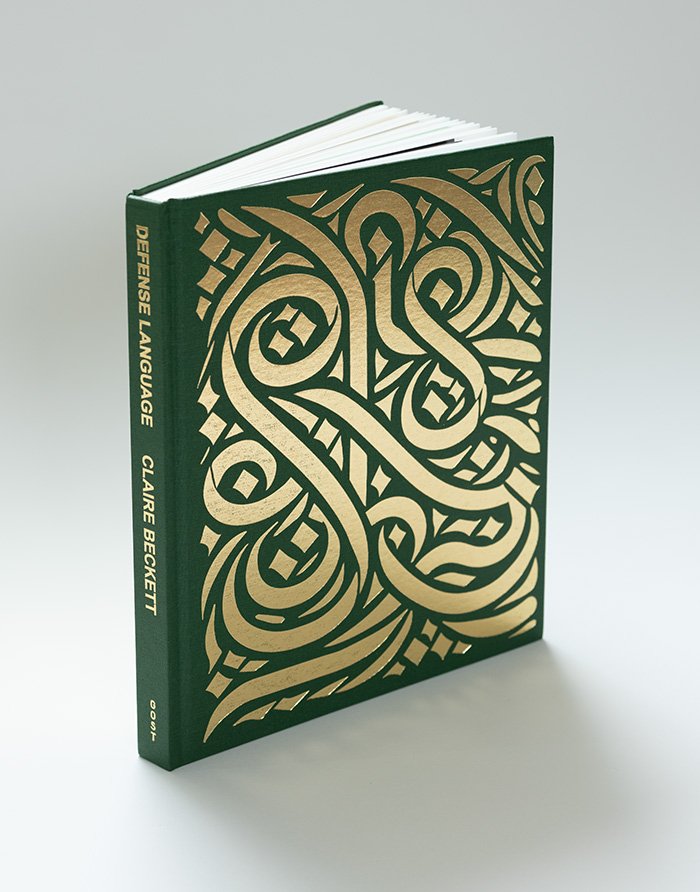
Defense Language is a large and glossy green leatherbound hardback with gold foil detailing on the cover, echoing the traditional covers of Qurans. All shot in Beckett's preferred large format, the 192-page book includes 136 color portraits and landscapes as well as printed ephemera, such as fold-out pocket guides used by American soldiers and Marines deployed to Iraq and Afghanistan.
Upon opening the book, we are immediately met with the expected symbols of a country such as Iraq or of the Islamic world: mosques, the characteristics of calligraphy, and even goats. But look just a little more closely and you'll discover this place has no connection whatsoever to Iraq. It is a confused cultural mashup, as if you'd asked an Al trained on Disney's 1992 Aladdin to depict the so-called "Middle East."
It is a book almost definitely aimed at viewers with a Westernized worldview and asks such readers what they know about this region. It challenges these biases, perceptions, and preconceived notions of countries such as Iraq and Afghanistan by confronting us with inaccurate depictions of peoples and the uncomfortable, violent truths of war.
Beckett, born and raised in Chicago and now based in Boston, served as a Peace Corps volunteer from 2002 until 2004 in the Republic of Benin in West Africa, where local communities were vehemently opposed to the US invasions of Iraq and Afghanistan post- 9/ 11. The locals would ask a young Beckett, "Why is your country doing this horrible thing?" But, as Beckett tells me, Peace Corps volunteers are not allowed to engage in political speech, which prompted her to find a different way to express her views through her photography. This catalyzed the project Simulating Iraq, though she'd been photographing since she was sixteen.
In one image, a fake town is depicted with the apparent gold dome of a mosque and its blue minaret, surrounded by sand-colored buildings complete with satellite dishes and telephone poles. It looks like a ghost town—devoid of anything that denotes human life. There is no sign of houseplants, clotheslines draped in laundry, shoes left by the door—the things that tell us people have lived a life here, that they have come and gone to see family or have made their homes more enjoyable to live in.
This is where the flattening dehumanization and objectification of the region as a result of these training practices is most apparent—these desolate spaces which assume that the "other" is not like "us," and perhaps that there must be nothing worth protecting here to begin with. These eerily empty and ghostly landscape shots are Beckett's strength throughout the body of work. However, elsewhere in the book, Beckett also employs high contrast with a strong focus on color—especially green (coincidentally, Islam's holy color)—and light.
As absurd as these role-playing theatrics are for readers (especially those who are Iraqi and Afghan), it feels necessary that Beckett should be the one shining a light on these disturbing performances. Not only can Beckett, as a US citizen, gain clearance to access these high-security sites that many other photographers cannot, she also approaches the work as a distinctly American photographer, without trying to position herself as an outsider to the work. It seems that she is telling us about a militarized culture to which she belongs, even more reliable. It might be impossible to approach work like this objectively, but Beckett does her best not to impose herself—her identity or her belief system—on the images themselves. They feel, as much as any image can, observational and documentary.
Before the project, Beckett spent several years photographing American soldiers in basic training from 2004 to 2007. "These were soldiers that were just first joining the military before they were going to be deployed, and they were the youngest American soldiers," she tells me. "Everyone who was being trained was going to be deployed to Iraq or Afghanistan."
Beckett admires the "grand tradition" of portraiture in photography; Rineke Dijkstra is one of her favorite photographers. For her, photographing the youngest soldiers would "bring the war home for the American public." One day while doing so, she discovered an unexpected group of people in the woods on one of the training bases.
"They were basic training soldiers, but they were wearing weird, mixed-up, fake Arab costumes over their normal army uniform and still holding their M16 rifles. There were female soldiers but they were wearing Arab men's headcloths, or a sort of tied hijab, except not correctly." Beckett later learned that they were imitating Iraqi and Afghani insurgents or militia to train soldiers and marines who were to be deployed, and immigrants from Iraq or Afghanistan intended to make the training look and feel realistic were sometimes present. Beckett claims that the US Army and Marine Corps are "incredibly mission driven; they are 100 percent focused at all times on getting the job done. So you can deduce they thought what they were doing was helping get the mission done."
In Jean Baudrillard's seminal 1981 text Simulacra and Simulation, he describes the fourth stage of simulation to be pure simulacrum—a copy of a copy, existing purely as its own self-referential entity. Here is where Aladdin becomes important again: Beckett's images reflect an imagined Middle East which has been illustrated and reinforced almost entirely by popular American media. These included animations and films, pop songs, and literature that skyrocketed in popularity post-9/11 and during the occupation of Iraq and Afghanistan. These media originated from inaccurate source material and were regurgitated again and again until the idea of a place and its people had no relation to reality.
"Simulating" is an accurate word for Beckett's project, in the sense that in a simulation, something is always glitching, which makes for its uncanny effect. In the simulation, objects are not only flattened, but are representations of representations, meaning they take on an absurd, right, but not quite. That space between almost right and not quite is where the viewer takes on an important role, because it is in this space that their own imagination and ideals find their place by attempting to make sense of the images. Beckett's series allows for this space to occur naturally by not imposing her own language onto the images.
Defense Language seems primarily concerned with confronting and challenging the American understanding of Islamic cultures and the cultures of the country's "opponents," while also inviting readers to critically examine where that fear and othering stems from—fear which often shapes those understandings. An important part of that process—especially for soldiers who will be encountering Arabic or Pashtu speakers for the first time—is learning how to communicate with them. One could assume this is in an effort to connect on a human level to the peoples of Iraq and Afghanistan; another perspective would be that once language barriers are removed, there is nowhere for civilians to hide from an army.
The book takes its name from the Defense Language Institute, creator of a booklet titled Saudi Arabic: Language and Culture Familiarization Course. The idea that language can be weaponized is not a new one but is nonetheless salient here. How else does a military become excused than by framing innocent victims as "collateral damage," or offensive attacks as "liberation"?
The book is purposely indirect, with no text explaining the project, but plenty of ephemera—pamphlets and posters—bound into the book itself, found among the pages. "I find it pretty boring from an artistic perspective to [explain the work] too explicitly," Beckett says. "Because I do think a viewer needs to work a little bit to engage with art in order for it to be their own, in order for them to do the critical thinking they need to do to engage and make meaning."
These pamphlets bring us further into the simulation and into the experience of the soldiers depicted. In a way, they incriminate us in the simulatory act, too. We can handle and read these documents the way the training intends, making this experience not something objective, but something intimate and visceral for the reader.
The printed materials, which she collected over time, come from Beckett's military base visits. During the pandemic, when Beckett couldn't visit any bases, she would scour eBay and the internet for other materials, setting a search tracker which would alert her every time a new item was added. She eventually acquired a huge amount of material that she would pair with the images, but she says they never felt right; "the documents were fighting with the photographs," she tells me. Director Stuart Smith at GOST, the book's publisher, decided to include the booklets in their entirety by unbinding each publication, scanning it page-by-page, and reprinting it onto textured paper to be rebound into Defense Language.
There is something unsettling about a sympathetic approach to photographing any military force—be it within the US or beyond. Beckett tries to maintain respect for the individuals photographed by allowing the printed ephemera to do the critical work, from which the project benefits: "They're just one person in this giant machine. The critique doesn't really need to land on that person. It needs to land on the machine."
But perhaps the project would have further benefited from a clearer regard for the ways in which these training grounds directly harm the people they impersonate, which would have helped the project feel more rounded.
Nevertheless, in some ways, the book has almost nothing to do with the wars in West Asia and almost everything to do with the ways in which the American public perceives foreign countries and cultures so far removed from its own. It is a wildly interesting—if not deeply confrontational—account of how culture is weaponized in armed conflicts.
Perhaps this is what makes the book feel particularly strange to encounter today. Its images belong to a very specific moment in American history, but the distance between that moment and the present feels increasingly difficult to locate. With the twenty-five-year anniversary of 9/11 having just passed, and another war unfolding with Iran, the language of the "Middle East" and the images attached to it seem to have acquired a kind of permanence. What was once constructed for the purposes of training starts to feel less like a simulation and more like a visual language we have never really stopped speaking.