Portfolio: Claire Beckett

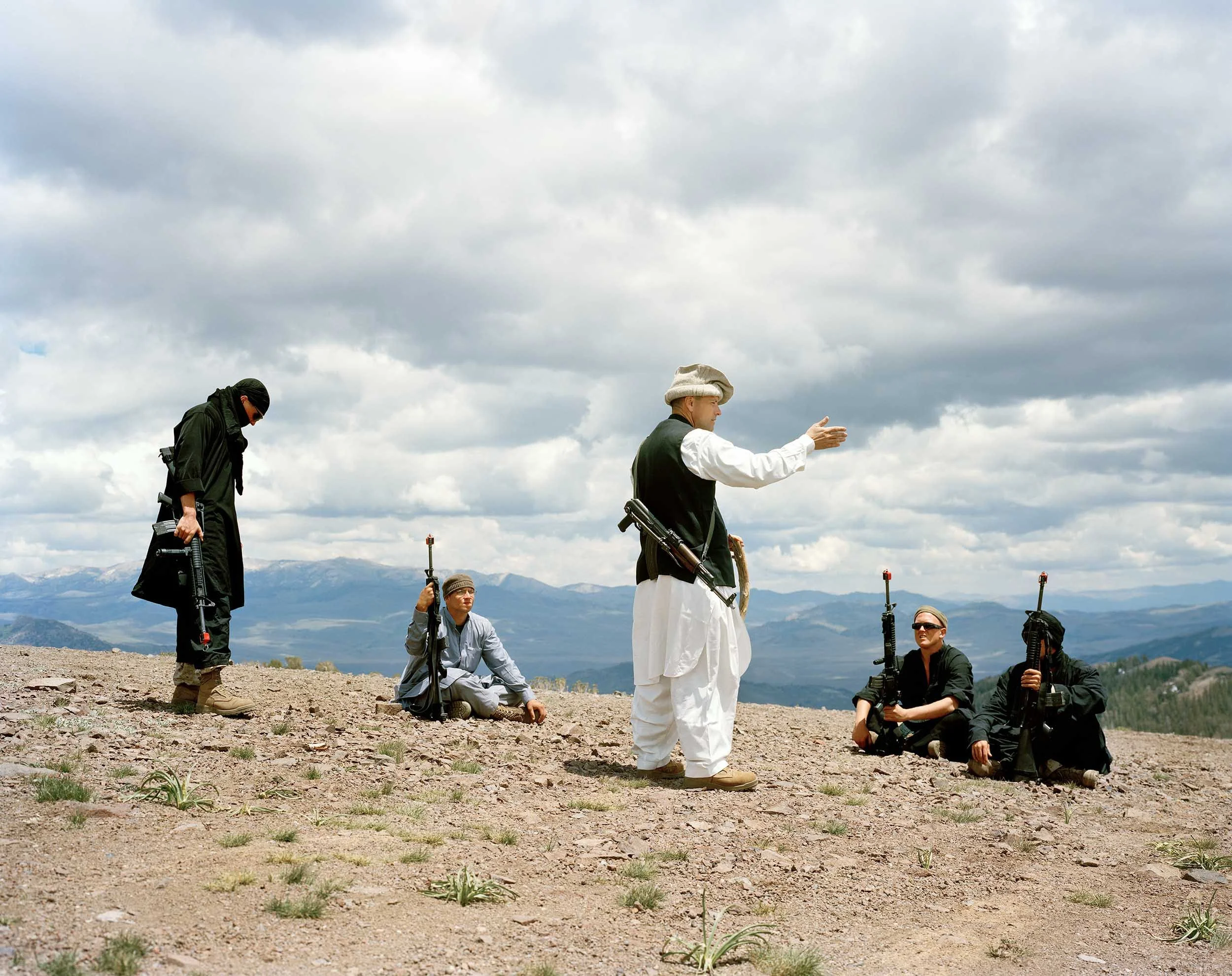
Marine Major John Cowait playing the role of a warlord holding a Taliban training camp on a remote Afghan mountaintop, 2009. From Defense Language c. Claire Beckett
January 16, 2026
By Jan Desloover
Before American troops go to war in Iraq or Afghanistan, they dress up as the enemy in replica villages at home. To defeat your enemy, you must become your enemy, argued Sun Tzu in the fifth century BC classic The Art of War. The American army still takes that motto to heart. For her project Defense Language, Claire Beckett (born 1978) spent almost twenty years visiting military bases in the US where soldiers prepare for counterinsurgency missions in Islamic areas, specifically Iraq and Afghanistan—soon Iran as well? These are often gigantic sites. Fort Irwin in California, for example, is more than 2,500 square kilometers in size.
Entire villages are recreated, including a mosque with a golden dome, a halal butcher shop, a supermarket, a bicycle repair shop, and satellite dishes. Goats and donkeys roam around, and of course, people too. At first glance, they look like Iraqi or Afghan locals, but they aren't: this is acting. War veterans don Islamic robes and play the roles of innocent civilians, Al-Qaeda members, Taliban fighters or suicide bombers. Volunteers are also recruited from Afghan and Iraqi communities in the US to promote authenticity. They are asked, among other things, to sell vegetables on the street – and speak Arabic – or simply stroll around or drink tea.
That so-called realism is, however, made of quite a bit of cardboard. Cliches reign, Beckett observed. Ask an old-fashioned B-movie director in Hollywood to sketch Iraqi or Afghan good guys and bad guys, and you get the stereotypes that Beckett photographed. Beckett believes there's a cultural sense of superiority. It's also present in the documents soldiers receive in preparation for a mission. The "culture smart card" on Afghanistan offers, among other things, ten don'ts. "Don't tell an Afghan he's wrong if he gives incorrect information. That is considered an insult." "Don't sit with the soles of your feet facing someone. That indicates that that person is beneath you." In Iraq: "Don't engage in religious discussions." "Don't make an okay gesture or give a thumbs-up; those gestures are considered obscene." "Don't overvalue an Iraqi's possessions. He might give them to you and expect something of equal value in return." There's undoubtedly some truth in it, but it's all also incredibly unsubtle and superficial. Show the Americans one Iraqi or Afghan, or at most a handful, and they know the whole nation.
In the Trump era, the American view of the outside world is more binary than ever. And as always happens with autocrats, the president also looks increasingly inward. In September, he and his "Secretary of War," Pete Hegseth, summoned nearly eight hundred top military personnel to Virginia. They had to prepare for a fight against "the enemy from within." As NRC Handelsblad recently wrote: "You wonder in what setting the soldiers will soon be training at Fort Irwin."