“Defense Language:” Claire Beckett

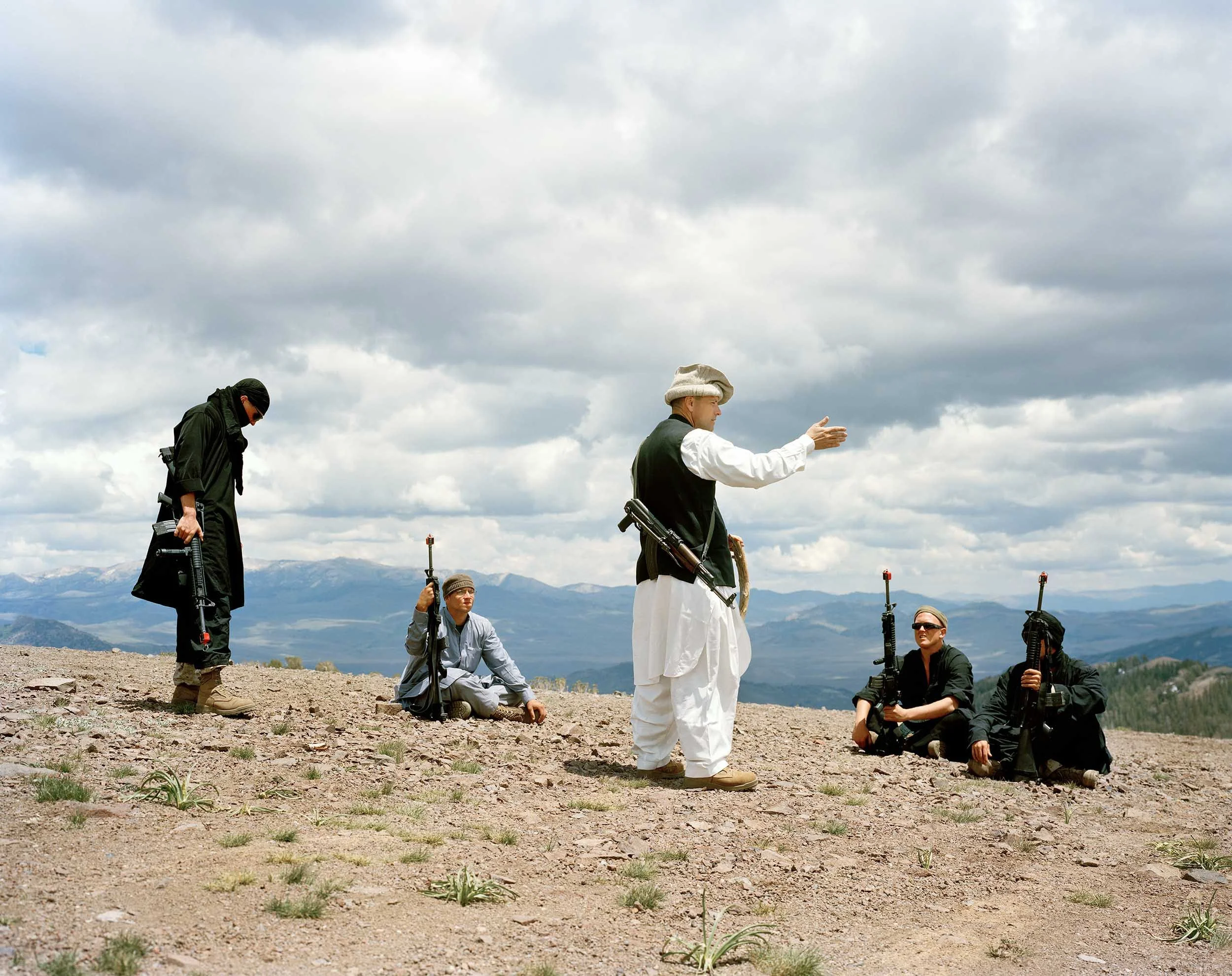
Marine Major John Cowait playing the role of a warlord holding a Taliban training camp on a remote Afghan mountaintop, 2009. From Defense Language c. Claire Beckett
Defense Language
Claire Beckett
GOST £45
December, 2025
Claire Beckett's Defense Language is a hunting and incisive examination of how the US military rehearses its encounters with the rest of the world. Over the course of nearly two decades, Beckett embedded herself within American bases across the country – from Fort Irwin, California, to Fort Drum New York – photographing surreal simulations used to prepare soldiers for wars in Iraq and Afghanistan. The result blurs the boundary between documentation and performance, exposing the uneasy theatre of American power.
The photographs themselves are strikingly composed; formal portraits of role-players in headscarves and fatigues, landscapes of hastily built ‘villages’, and candid scenes of interaction between soldiers and civilians. Beckett’s lens captures the strange mix of sincerity and artifice that defines these spaces, in which immigrants and veterans alike play out scripted encounters meant to mimic ‘the enemy’. The images invite readers to consider not only how war is fought, but how it is imagined and rehearsed through cultural caricature.
Complementing the photographs are reproductions of military training manuals, language guides and propaganda materials, objects Beckett collected from eBay and archives, some dating back to the Vietnam era. These texts underscore the persistence of American biases, revealing a long history of stereotyping immersed within institutional frameworks.
Beckett’s own reflections, rooted in her post- 9/11 experience as a Peace Corps volunteer in West Africa, lend the work a self-critical dimension. She approaches her subject not as an outsider, but as a participant in the system she critiques, acknowledging her complicity as a US artist.
Defense Language serves as a meditation on the mechanics of representation and the moral cost of cultural misunderstanding. Beckett's project is both visually compelling and politically urgent – a quiet yet devastating indictment of the ways a nation constructs its ‘others’ in the name of security and control.